
Investment Thesis
South Africa’s electricity supply remains critically dependent on Eskom, the state-owned utility responsible for generating ~95% of the country’s power — of which ~80% (~42 GW) comes from aging, coal-fired power stations. Despite growing environmental pressure, coal will remain the dominant source of energy in the near term. However, Eskom’s infrastructure continues to deteriorate, with legacy coal plants increasingly prone to unplanned breakdowns and decommissioning.
Historically a low-cost power producer, Eskom’s financial mismanagement, underinvestment, and structural inefficiencies have led to double-digit annual tariff increases, a trend expected to persist amid declining capacity and a shrinking paying customer base. In 2023, South Africa experienced 335 days (~7,000 hours) of load-shedding — the worst on record — largely due to generation failures, underscoring systemic collapse.
2024, however, marked a sharp improvement. Load-shedding fell nearly 75% to ~1,650 hours, with Eskom achieving a historic run of almost 294 consecutive days without blackouts by early 2025. The utility’s Energy Availability Factor (EAF) improved to ~63.6% by late 2024, reflecting better operational management. Still, fragility remains: in 2025, while no load-shedding has occurred since May, Eskom’s EAF slipped back to ~56–57%, leaving the system exposed to winter demand pressures.
Eskom must add 14,000 km of transmission lines at a projected cost of $21 bn (R380 bn) over the next ten years. Yet, only 4,300 km were built in the last decade. With balance-sheet debt of $25 bn (R442.7 bn) and municipal arrears exceeding $5 bn (R90 bn), Eskom lacks the financial capacity to execute necessary upgrades. The risk of grid deterioration over the coming decade is high.
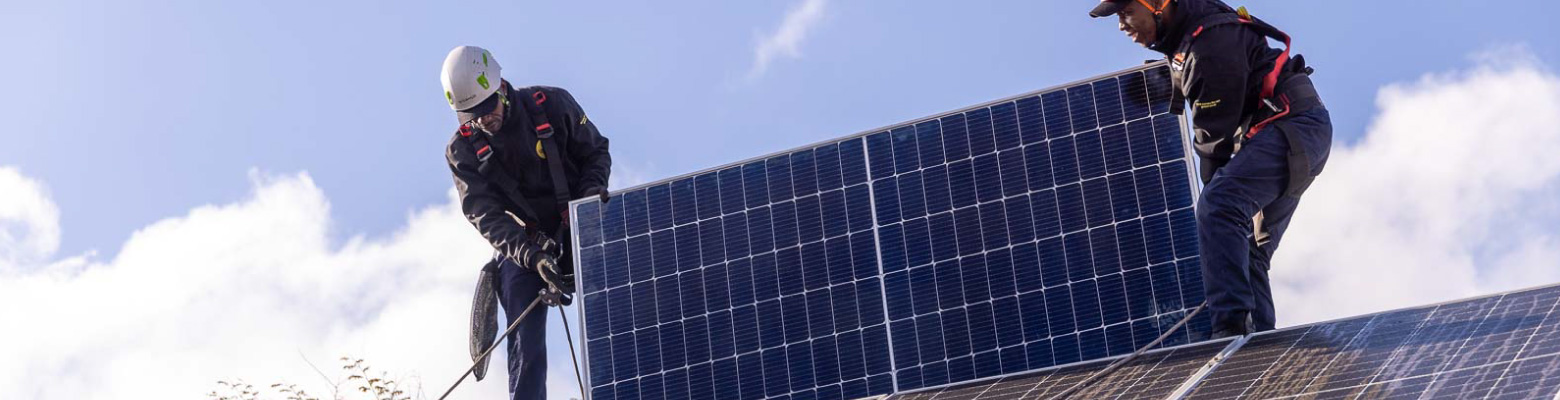
Investee: GoSolr
GoSolr is South Africa’s largest subscription-based residential solar provider, offering solar-as-a-service via flexible, month-to-month subscriptions—eliminating upfront CapEx and making solar accessible to middle-income households.
Customers benefit from:
- Cheaper, cleaner, and more reliable energy than Eskom
- Seamless integration and installation
- Transparent pricing
Recently, GoSolr launched “The Brain” — a proprietary smart energy platform that predicts solar generation using real-time weather forecasts, anticipates power outages (via social media monitoring and official data), and automatically manages home devices (e.g., geysers, pool pumps) to optimize solar self-use and battery backup. This positions GoSolr as more than a solar installer — it is an integrated energy technology platform.
Conclusion
While 2024 and 2025 improvements show Eskom is capable of short-term stabilization, the long-term trajectory remains one of structural deterioration. Rising tariffs, an aging coal fleet, insufficient transmission roll-out, and financial strain all point to enduring instability in South Africa’s electricity system.
In this context, GoSolr is not merely a consumer hedge — it is an integral, long-term piece of the national energy solution. By enabling households to generate and store clean power, GoSolr:
- Reduces pressure on the fragile grid
- Shields consumers from escalating tariffs
- Democratizes access to reliable electricity
- Builds distributed resilience at scale
Moreover, widespread adoption of residential solar could avoid millions of tons of CO₂ emissions by 2030, a significant contribution to South Africa’s climate goals and further reinforcing GoSolr’s role as both a societal and environmental catalyst.
As the nation’s largest home solar platform, GoSolr is positioned as both a critical household utility and a strategic partner in South Africa’s energy transition — strengthening grid stability, supporting decarbonization, and delivering direct economic and environmental benefits to millions of consumers.